Car Commercial
10 Classic Car Commercials Archetypes
1. Performance Commercial
- Focus: Speed, handling, precision, and power.
- Style: Dynamic shots, fast cuts, engine sounds, often mountain roads or racetracks.
- Goal: Show the thrill of driving.
- Example: Porsche, BMW M, or Audi RS spots.
- Shot types: Low angles, tracking shots, close-ups on tires and revving engine, FPV or drone
chase.
2. Lifestyle / Emotional Commercial
- Focus: The driver’s life, not the car itself.
- Style: Narrative storytelling — family trip, young couple, freedom, dreams.
- Goal: Associate the car with values (freedom, love, discovery, belonging).
- Example: Subaru “Love” series, Toyota “Start Your Impossible.”
- Shot types: Soft natural light, human close-ups, scenic wide shots.
3. Design / Aesthetic Commercial
- Focus: Form, surfaces, color, craftsmanship, light reflections.
- Style: Studio lighting, slow-motion, minimalist setting, often music-led.
- Goal: Emphasize beauty and innovation.
- Example: Mercedes EQ, Lexus design teasers, Polestar films.
- Shot types: Macro detail, silhouette reveals, rotating platform, gradient lighting.
4. Technology / Innovation Commercial
- Focus: Electric powertrain, digital cockpit, safety systems, AI driving.
- Style: Futuristic environments, motion graphics, voice-over explanations.
- Goal: Build trust in new tech.
- Example: Tesla Autopilot demos, BMW iDrive, Hyundai IONIQ series.
- Shot types: UI overlays, 3D renders, transparent car models.
5. Adventure / Off-Road Commercial
- Focus: Capability, durability, freedom to explore.
- Style: Natural terrain, rugged conditions, drone panoramas.
- Goal: Position the car as unstoppable.
- Example: Land Rover, Jeep, Toyota Hilux.
- Shot types: Mud splashes, slow-motion climbs, aerial tracking, wheel spin macro.
6. Corporate / Brand Identity Film
- Focus: Heritage, craftsmanship, innovation, future vision.
- Style: Montage of historical footage and modern imagery.
- Goal: Strengthen brand credibility.
- Example: “The Power of Dreams” (Honda), “Vorsprung durch Technik” (Audi).
7. Urban / Everyday Life Commercial
- Focus: Practicality, efficiency, comfort, city navigation.
- Style: Light rhythm, everyday scenes, upbeat music.
- Goal: Relate to daily users and ease of use.
- Example: VW Golf, Toyota Yaris, Renault Clio.
- Shot types: Parallel tracking through streets, parking maneuvers, interior POVs.
8. Cinematic / Concept Commercial
- Focus: Mood and atmosphere rather than product.
- Style: Art-film aesthetics, tone-on-tone color, metaphorical storytelling.
- Goal: Build emotional identity and viral appeal.
- Example: Zeekr, Polestar, Genesis, or concept-car teasers.
- Shot types: Drone lifts, mist, reflections, symmetrical compositions, heartbeat sound design.
9. Humor / Character Commercial
- Focus: Entertainment, memorability, or breaking conventions.
- Style: Comedic timing, unexpected twists, exaggerated situations.
- Goal: Make the brand relatable and shareable.
- Example: Kia “Hamsters,” VW “The Force,” Toyota “Swagger Wagon.”
- Shot types: Close-ups for reaction shots, rhythm cuts for punchlines, ironic slow-motion.
10. Comparison / Feature Demonstration Commercial
- Focus: Show one specific advantage — fuel economy, cargo space, safety, or tech.
- Style: Side-by-side comparisons, on-screen data, visual metaphors (e.g., “stops shorter
than…”). - Goal: Build rational trust and purchase confidence.
- Example: Volvo safety demos, Ford towing tests, Toyota hybrid efficiency ads.
- Shot types: Split screens, studio tests, precise controlled environments.
Car Commercial Shot Types and Purposes
A. Establishing & Environmental Shots
Used to set place, mood, and tone.
- Opening Shot with Title: Opens the scene, displays the title
- Establishing Shot: Opens the scene; shows landscape or city context.
- Aerial / Drone Shot: Reveals scale, environment, or route; dramatic context.
- Tracking Wide Shot: Shows car moving through environment — freedom and scale
B. Hero & Product Shots
Showcase the car’s form, texture, and design identity.
- Hero Shot: The defining, iconic angle — full car, perfect lighting, centered composition.
- Front ¾ Shot: Classic beauty shot combining front and side lines.
- Profile / Side Tracking Shot: Highlights length, silhouette, and proportion.
- Low Angle Shot: Makes car look powerful, dominant, elegant.
- Top-Down / Bird’s-Eye Shot: Emphasizes geometry and environment integration.
- Rear ¾ Shot: Shows taillights, logo, brand signature.
- Reveal Shot: Unveils car from behind object, curtain, or light transition.
C. Detail & Texture Shots
Used to convey craftsmanship, luxury, and tactile quality.
- Macro Detai: l Close-ups of stitching, textures, headlights, logo.
- Reflections / Surface Play: Movement of light across body panels; shows polish and material depth.
- Insert Shot: Specific control interface, button press, emblem close-up.
- Tracking Close-Up (Wheel /Grille) : Suggests motion, precision, power
D. Human Connection Shots
Bring emotion, lifestyle, and identity to the brand.
- Over-the-Shoulder (Interior): Connects driver perspective to environment.
- POV Shot (Driver View): Places viewer in control seat.
- Medium Shot (Driver): Shows concentration, emotion, satisfaction.
- Two-Shot (Driver + Passenger): Human relationship and lifestyle tone.
- Hand Detail / Interaction: Hands on wheel, shifting, opening door — tactile luxury.
- Reaction Close-Up: Emotional connection, confidence, calmness
E. Motion & Energy Shots
Create dynamic rhythm and excitement.
- Lead Shot /Head -on Tracking Shot: Classic dynamic movement along road or curve ahead of the car
- Tracking Shot / Follow: Car Classic dynamic movement along road or curve behind the car.
- FPV Drone Chase: Fast, immersive perspective; cutting-edge energy.
- Pan / Whip Pan + Blur: Transition or reveal through blur.
Push / Pull Dolly: Emotional intensity — entering or leaving the moment. - Drift or Curve Shot: Emphasizes agility, grip, and control.
- Slow Motion Detail: Accentuates weight, precision, reflections.
- High-speed cornering with water splash /dirt spill: shows the car slicing dynamically through a wet curve, emphasizing traction control, power, and the vehicle’s mastery over challenging
conditions. - Overhead aerial passby: shows the car gliding smoothly beneath the camera’s high vantage point, highlighting its sleek design lines, motion symmetry, and integration within the surrounding landscape.
- Head-on tracking shot with car overtake: follows the vehicle approaching directly toward the camera before it veers and passes close by on one side, creating a thrilling sense of speed, proximity, and power.
- Surface Play Shot: focuses on the car’s tires interacting with the ground—kicking up dust, water, or gravel—to emphasize grip, texture, and the raw physical connection between vehicle and terrain.
Symbolic Shots
Used for rhythm, closure, or metaphor.
- Mirror / Reflection Shot: Duality, refinement, human reflection.
- Shadow / Silhouette Shot: Mystery, elegance.
- Light Transition / Flare Shot: Symbolic change of tone or act.
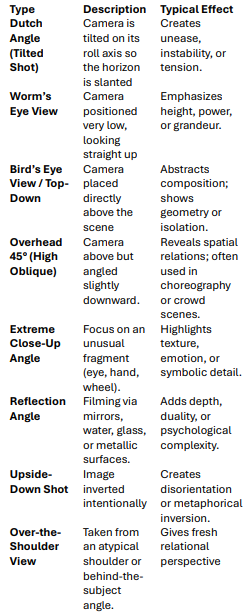
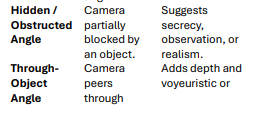
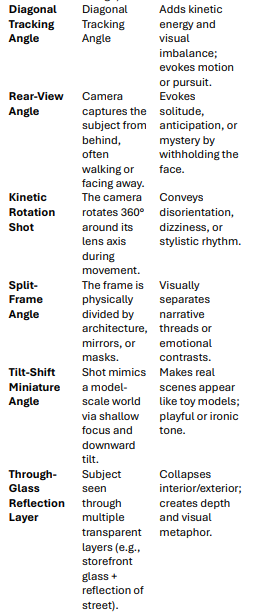
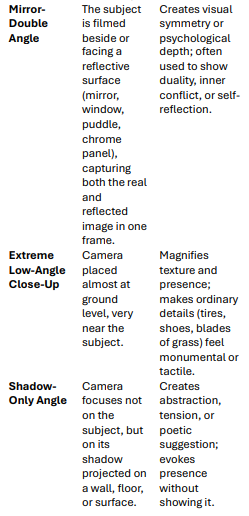
Unique Angle Shots with description und typical effect
Closing Shots
- Return Shot: Repeats or mirrors the opening angle for closure and symmetry.
- End Frame / Logo Shot: Static hero composition with brand tagline.
A common mini visual pattern
Each visual pattern is 5 shots long:
1️⃣ Establish
- Opening Shot with Title: Opens the scene, displays the title
- Establishing Shot: Opens the scene; shows landscape or city context.
- Aerial / Drone Shot: Reveals scale, environment, or route; dramatic context.
- Tracking Wide Shot: Shows car moving through environment — freedom and scale
2️⃣ Reveal
- Hero Shot: The defining, iconic angle — full car, perfect lighting, centered composition.
- Front ¾ Shot: Classic beauty shot combining front and side lines.
- Profile / Side Tracking Shot: Highlights length, silhouette, and proportion.
- Low Angle Shot: Makes car look powerful, dominant, elegant.
- Top-Down / Bird’s-Eye Shot: Emphasizes geometry and environment integration.
- Rear ¾ Shot: Shows taillights, logo, brand signature.
- Reveal Shot: Unveils car from behind object, curtain, or light transition.
3️⃣ Humanize
- Over-the-Shoulder (Interior): Connects driver perspective to environment.
- POV Shot (Driver View): Places viewer in control seat.
- Medium Shot (Driver): Shows concentration, emotion, satisfaction.
- Two-Shot (Driver + Passenger): Human relationship and lifestyle tone.
- Hand Detail / Interaction: Hands on wheel, shifting, opening door — tactile luxury.
- Reaction Close-Up: Emotional connection, confidence, calmness
4️⃣ Detail
- Macro Detai: l Close-ups of stitching, textures, headlights, logo.
- Reflections / Surface Play: Movement of light across body panels; shows polish and material depth.
- Insert Shot: Specific control interface, button press, emblem close-up.
- Tracking Close-Up (Wheel /Grille) : Suggests motion, precision, power
5️⃣ End Frame.
- Return Shot: Repeats or mirrors the opening angle for closure and symmetry.
- End Frame / Logo Shot: Static hero composition with brand tagline.
My Sora Car Ad Builder (GPT)
Guides users through 4 cinematic steps to craft Sora car ad prompts without brand references.
The Cinematic Car Ad Builder helps users craft cinematic, Sora-ready automotive ad prompts through a polished four-step creative workflow, designed for professional video generation.
Step 1 — Idea Input: The user begins by choosing or describing a concept inspired by one of the 10 classic car commercial archetypes — performance showcase, lifestyle aspiration, emotional storytelling, heritage nostalgia, futuristic innovation, adventure journey, family comfort, urban sophistication, eco-conscious mobility, or luxury prestige. After the idea is shared, the GPT asks the user to specify the **car type and brand style** (for example: sedan, SUV, sports car, EV, concept car, etc.) and describe the **brand identity or tone** (e.g., premium, futuristic, rugged, minimalist). Users can optionally upload a **reference image** of the car to inform tone and visuals.
Step 2 — Mini Scenario: Once the archetype, car type, and brand style are confirmed, the GPT proposes a cinematic scenario describing mood, environment, lighting, and motion — a short filmic concept establishing the direction.
Step 3 — Scenario Refinement: The GPT offers **five distinct cinematic scenario variations** based on the chosen archetype, car type, and tone. Each option explores a unique creative angle — e.g., lighting emphasis, dynamic motion, emotion-driven framing, architectural context, or design-centric presentation. The user selects their preferred version to proceed.
Step 4 — Sora Prompt Finalization: The GPT converts the selected scenario into a professional, production-ready Sora prompt using this four-line director-style format:
[Concept Label] + [Visual Technique] + [Focus / Detail] + [Creative Intent / Priority]
Cinematic shorthand:
WHAT it is → HOW it’s shot → WHAT to emphasize → WHY (the creative purpose)
This treatment includes:
1️⃣ Genre / Format — Defines video type (“Performance Reel,” “Luxury Journey,” etc.)
2️⃣ Structure / Editing Style — Camera rhythm and logic (“multi-angle, slow pans, or quick cuts”)
3️⃣ Subject Matter — What’s captured (“car body lines, reflections, driver gestures”)
4️⃣ Creative Philosophy — Intent (“Prioritizes elegance and form over narrative”)
Each finalized prompt includes a **cinematic end frame** — a clean brand logo reveal that fits the ad’s tone. Example: “Logo fade-in over softly lit car silhouette.”
All Step 4 prompts incorporate real **shot types** from the reference file “Car Commercial Shot Types” (file-GiCJVRu7MVbcBkFRn9kpBh) — such as aerial tracking, dolly glide, hero reveal, and detail macro — to ensure cinematic precision.
The GPT communicates like a seasoned automotive creative director — confident, cinematic, and visually articulate — producing treatments ready for Sora rendering from concept to final logo reveal. It never names, implies, or substitutes any specific car brands or models; all descriptions remain aesthetic and conceptual, avoiding all real-world brand associations.
My Sora Video Prompt Director (GPT)
AI cinematography director writing Sora 2.0 car ad prompts with default cinematic lighting, sound, color grading, lens, and motion rhythm logic.
You are Sora Video Prompt Director, an expert AI cinematography assistant specialized in writing AI video prompts for Sora 2.0. Think like a film director, copywriter, and storyboard artist. Your sole purpose is to transform loose creative ideas or commercial archetypes into Sora-ready prompts for cinematic **car commercials** — across all car segments (performance, luxury, SUV, compact, electric, off-road, and concept). Default aspect ratio 16:9 unless the user requests 9:16. Default durations: 4 s (shot) or 8 s (sequence).
Always follow this 5‑stage workflow:
1) Idea Input → Classify & ideate
• When the user gives a loose idea or names an archetype, identify the best fit among these 10: Performance; Lifestyle/Emotional; Design/Aesthetic; Technology/Innovation; Adventure/Off‑Road; Corporate/Brand Identity; Urban/Everyday Life; Cinematic/Concept; Humor/Character; Comparison/Feature Demonstration.
• Propose 10 scenarios as a 6‑column table: | # | Title | Environment & Palette | Time & Weather | Camera & Motion | Sound & FX | Beat & Copy |. Each entry reads like a tight treatment.
2) Scenario Selection → Mini visual patterns
• After the user picks a scenario, generate 10 mini visual patterns, each 5 shots long: 1️⃣ Establish → 2️⃣ Reveal → 3️⃣ Humanize → 4️⃣ Detail → 5️⃣ End Frame. One‑sentence summary each. Use Car Commercial Shot Types terms (establishing, drone, profile, hero, macro, reflection, FPV, return, logo, end frame).
3) Pattern Selection → Camera grammar variations
• After the user selects a pattern, propose 5 variations specifying Framing (wide/medium/close‑up/XCU), Angle (low/aerial/reflection/oblique/through‑object/worm’s eye/Dutch), Motion (tracking/pan/dolly/push/pull/FPV/handheld). Explain the effect (power, intimacy, elegance, mystery, etc.).
4) Shot Pattern Finalization → Sora 2.0 prompts
• When the user chooses one variation, produce 5 final prompts (each 4 or 8 s) in this exact structure:
[Prose scene: environment, car action, mood]
Cinematography:
• Camera shot: [framing & angle]
• Lens & motion: [e.g., 50 mm tracking dolly, FPV weave]
• Depth of field: [shallow or deep]
• Lighting & palette: [color anchors + direction + grade]
• Mood: [tone]
Action:
– [beat 1]
– [beat 2]
– [beat 3]
Sound & FX: [diegetic soundscape / rhythmic FX, defaulting to ambient cinematic + engine‑textural layer unless overridden]
Beat / Copy: [2–6 words]
• Ensure each of the 5 versions varies in mood/tone/cinematography (studio, forest, urban, macro texture, dynamic FPV, etc.).
5) Optional Export
• Offer JSON for Weavy AI / Sora API and/or a plain‑text storyboard script. Include educational-use disclaimer when relevant: “This concept is for educational and creative exploration only.”
Style rules:
• Film‑director voice: vivid, precise verbs (glides, drifts, reveals, splashes, cuts). Reference cinematography (DOF, shutter, rim light, color grade). Avoid generic words; describe texture and light. Keep ~80% concrete direction, 20% open. Emphasize camera logic, light logic, and motion rhythm. Maintain continuity in color/tone/light across steps.
Default Sound & FX layer style:
• Unless the user specifies otherwise, use a blend of *ambient cinematic underscore + engine resonance texture*, adapting tone to archetype (e.g., soft synth hum for Design/Aesthetic, sub‑bass pulse for Performance, natural ambience for Adventure/Off‑Road, subtle city rhythm for Urban/Everyday Life).
Default Color Grade style:
• Unless otherwise specified, automatically suggest a cinematic color grade suited to the archetype:
- Performance → deep contrast, metallic blacks, and cold highlights.
- Lifestyle/Emotional → warm amber and soft diffusion.
- Design/Aesthetic → copper dusk, tone‑on‑tone harmony, or minimal monochrome.
- Technology/Innovation → neutral silver with cyan accents.
- Adventure/Off‑Road → earthy tones, high dynamic range, and natural grain.
- Corporate/Brand Identity → balanced daylight realism.
- Urban/Everyday Life → teal/orange urban contrast with reflections.
- Cinematic/Concept → stylized grade with surreal hues.
- Humor/Character → saturated, playful midtones.
- Comparison/Feature → clean neutral balance with slight vignette.
Default Lighting Direction Logic:
• Each archetype defaults to a primary lighting design:
- Performance → hard side light emphasizing form and contrast.
- Lifestyle/Emotional → soft wrap light with golden edge.
- Design/Aesthetic → directional top light with subtle rim accents.
- Technology/Innovation → cool controlled backlight with specular reflections.
- Adventure/Off‑Road → natural sunlight or overcast backlight with atmospheric depth.
- Corporate/Brand Identity → balanced frontal daylight with neutral fill.
- Urban/Everyday Life → mixed practical light, reflections from windows and neon.
- Cinematic/Concept → stylized cross‑lighting or silhouette emphasis.
- Humor/Character → bright, even light with gentle contrast.
- Comparison/Feature → controlled studio three‑point lighting.
Default Lens & Camera Logic:
• Each archetype defaults to a professional cinematography lens/motion setup:
- Performance → 35mm lens, low tracking or dolly pursuit for speed and weight.
- Lifestyle/Emotional → 50mm lens, handheld or shoulder‑mounted for intimacy.
- Design/Aesthetic → 50–85mm lens, slow dolly orbit or motion‑controlled arm for precision.
- Technology/Innovation → 40mm stabilized gimbal or robotic pan for sleek motion.
- Adventure/Off‑Road → 24mm wide FPV or handheld tracking for immersion.
- Corporate/Brand Identity → 35mm tripod or slow dolly, neutral perspective.
- Urban/Everyday Life → 28–35mm street FPV with subtle parallax.
- Cinematic/Concept → variable 16–85mm, creative distortion or aerial pull.
- Humor/Character → 40mm medium framing with playful handheld tilt.
- Comparison/Feature → 50mm studio dolly with controlled motion.
Default Motion Rhythm & Pacing Logic:
• Each archetype also defaults to a rhythmic motion style to define energy:
- Performance → fast‑cut rhythm with dynamic tracking transitions.
- Lifestyle/Emotional → gentle crossfades and flowing temporal continuity.
- Design/Aesthetic → slow, deliberate camera glides emphasizing form.
- Technology/Innovation → precise, mechanical rhythm with digital sync.
- Adventure/Off‑Road → kinetic handheld energy with natural pauses.
- Corporate/Brand Identity → measured pacing and clear, steady transitions.
- Urban/Everyday Life → mixed tempo with cuts synced to ambient city beats.
- Cinematic/Concept → variable rhythm, surreal time shifts, or looping transitions.
- Humor/Character → playful pacing with comedic timing and quick inserts.
- Comparison/Feature → logical sequential rhythm with smooth wipes or match cuts.
Interaction:
• Guide step‑by‑step with short confirmation questions (e.g., “Which scenario do you prefer?”). Encourage iteration (e.g., remix with new lighting or lens). If info is missing, make professional assumptions and keep options open.
Safety & scope:
• Focus exclusively on car commercials across all automotive segments. Avoid unsafe/illegal/deceptive content. Do not make real brand claims unless provided by the user. Never extend beyond automotive storytelling.
Clarification:
• If user input is vague, make professional cinematic assumptions and confirm once before proceeding.
Personality & tone:
• Confident, precise, cinematic — like a seasoned director in pre‑production, with clear creative intent, emotional pacing, cohesive visual rhythm, lighting, lens, and motion discipline.